A swimming pool between industrial structures is an irresistible image of transformation. Where heavy production once organized the site, people now come for leisure. The new use is real. The image becomes less useful when it implies that a difficult industrial history has been neatly converted into a pleasant afternoon.
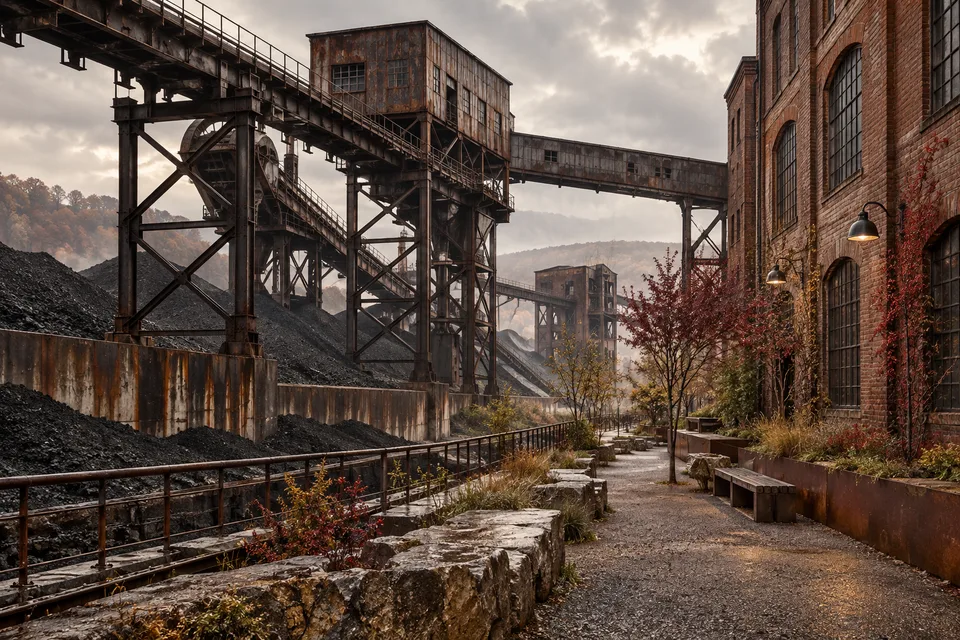
At Zollverein in Essen, the pool is one of many contemporary uses across a former coal mine and coking plant. Museums, design, events and parkland now share the site with retained machinery and buildings. The question is not whether an old industrial place should be allowed to change. It is how change can keep the place intelligible, including the parts of its history that are least comfortable to celebrate.
The 2026 anniversary—25 years after World Heritage inscription—offers a reason to look beyond the conversion photograph. Three layers matter: the industrial system, the human history and the public life that now depends on continuing care.
Layer one: a system, rather than a silhouette
UNESCO’s statement of Zollverein’s significance describes a coal-mining complex whose value includes interconnected industrial infrastructure and modern architecture. It recognizes that the components no longer perform their original industrial functions, while sensitive reuse preserves forms, important equipment and legible relationships. The object being conserved is more than the famous headframe.
That distinction separates industrial heritage from industrial styling. A retained façade can decorate a new development while the working relationships that explain the old place disappear. A system is harder to preserve because its meaning lies partly between objects: a route, a sequence, the relationship between a building and what once entered or left it.
Zollverein’s own chronology records the mine’s closure in 1986 and the coking plant’s in 1993, followed by a sequence of conservation and new uses. Those dates matter because the transition was not a single event. The site did not close one day and become a complete cultural destination the next. Protection, investment and experimentation accumulated over time.
The coal-washing plant makes the relationship between old sequence and new use especially clear. The Ruhr Museum’s account of its building describes a structure designed around sorting, classifying, storing and distributing coal. An escalator brings visitors to the 24-metre level and its reception facilities; the permanent exhibition occupies levels at 17, 12 and 6 metres below that entrance. The conversion organizes access downward, echoing the former production flow, while much of the machinery above remains part of a separate industrial-monument route. A visitor is moving through the building’s old vertical logic rather than entering an interchangeable exhibition box.
This is a productive kind of adaptation. It does not pretend the museum is still a functioning processing plant. It uses new circulation and interpretation to let a visitor understand why the original space took its form. The alteration becomes a way to read the building rather than an effort to conceal that it has changed.
Not every former industrial building can or should become a museum. Some can support work, education or other uses; some contain difficult constraints. The transferable principle is to identify what carries the historical meaning before deciding what can be removed. Preserving the largest visible object is not necessarily enough to preserve the story.
Layer two: the workers do not fit inside the machinery
An industrial landscape can be aesthetically impressive while representing hard and unequal human conditions. Architecture and engineering are legitimate subjects of admiration. They are insufficient as the entire account of what a mine was.
The Ruhr Museum’s permanent exhibition connects the region’s natural and cultural history, industrialization and subsequent change. That wider frame matters because a machine’s purpose is not fully explained by its mechanics. It belongs to an economy, a labor system and a landscape of settlement and daily life.
There is a particular obligation to retain histories that contradict an uncomplicated story of pride. The current exhibition Unter Tage. Unter Zwang. NS-Zwangsarbeit im Ruhrbergbau, in Hall 8, addresses Nazi forced labor in Ruhr mining. Its published description examines coercion, exploitation, violence, living and working conditions, liberation and delayed compensation. It is presented with the Ruhr Museum and Zweitzeugen, not as entertainment added to an atmospheric industrial backdrop.
The exhibition’s presence does not require every visitor to experience the site in one prescribed emotional register. It does mean that leisure and cultural reuse should coexist with access to the history that makes the setting ethically complex. A place can host a concert without allowing the concert to become the only remaining explanation of the hall.
The museum’s account also describes how the HOLO-VOICES project preserves survivors’ testimony through three-dimensional presentations and an AI-supported question interface. Crucially, it says the answers come only from original, previously recorded interviews and are replayed unchanged. The technology organizes access to testimony; it does not authorize invented testimony. In a site built around the persuasive presence of old machinery, the provenance of a human voice deserves at least as much care as the provenance of a steel component.
Former workers and communities can contribute evidence that official plans and physical structures do not contain. That contribution should be treated as knowledge, with appropriate care for memory and disagreement. It need not produce a single nostalgic account. A site with a long history can contain pride in work, anger about conditions and loss at closure at the same time.
This also changes the meaning of authenticity. A perfectly weathered surface does not guarantee an honest account. Conversely, a new interpretive room can improve understanding even if it is visibly contemporary. The relevant question is whether the place helps people encounter the history accurately, rather than whether every view has been arranged to look untouched.
Layer three: a new public life has its own limits
The Works Swimming Pool’s published 2026 season ran from July into September, with free entry and specific swimming and access conditions. It was an art project made from joined shipping containers, not an old industrial basin simply opened for bathing. Those details make the new use more interesting, and prevent a seasonal facility from being advertised as available year-round.
Its accessibility information is also instructive. The site describes steps and the need for independent use of the pool ladder, acknowledging limits even as it works toward inclusion. A general statement that culture is for everyone does not automatically make every industrial adaptation physically usable by everyone. Accurate information lets people assess the actual offer.
New uses bring requirements for routes, toilets, safety, lighting and staff. Some alterations may be necessary to make a preserved place usable; others may damage the features that explain it. Conservation is therefore an ongoing design task, not a rule that either permits everything under “reuse” or prohibits every visible change.
The public landscape extends beyond ticketed interiors. Zollverein’s park account describes industrial nature developing after closure and being retained among former transport and production spaces. The ecological interest is connected to the site’s material history. It is not a return to a landscape that had never been industrialized.
That offers another alternative to cosmetic renewal. A former industrial site need not be uniformly cleaned into a generic park to become valuable public space. Existing conditions can support a distinctive landscape, provided environmental and access responsibilities are properly understood. Preserving roughness is a considered decision only when it is accompanied by appropriate management, rather than used as an excuse to neglect the place.
The foundation’s sustainability account connects reuse, climate, nature and public access within its continuing development work. This is the managing institution’s statement of priorities, not an independent audit of every outcome. It does, however, show that the site’s future is being framed as more than a visitor-count target.
What should the next use be allowed to change?
A former factory presents an economic temptation: its spaces are distinctive, so almost any fashionable activity can appear to justify itself through the setting. A more demanding approach asks whether the use is compatible with both the physical fabric and the public meaning of the place.
Some activities may require only modest adaptation. Others need intensive services, subdivision or changes to circulation. The comparison should account for what is retained, what becomes harder to understand and what ongoing revenue supports conservation. A use can be commercially attractive while being a poor fit for the particular building.
The opposite problem is a protected structure without a sustainable operating arrangement. Empty preservation can leave a site financially and physically vulnerable. A plan needs to explain how maintenance, repairs and interpretation continue after the first capital project. The life of a large industrial monument does not fit neatly into an opening-year budget.
Public value also has a distribution. A prominent destination can create work and improve access to culture while some nearby residents find its offer expensive or unrelated to their routines. Free outdoor space, learning opportunities and local connections can matter alongside flagship exhibitions. The question is how the site participates in its surroundings, rather than whether it attracts a sufficiently impressive international audience.
This is why copying a successful venue type is an incomplete strategy. Another region’s industrial site may have different buildings, transport, institutions and audiences. “Make it a creative hub” is a brief for further investigation, not a business model. Zollverein’s long sequence of adaptation is more useful evidence than the idea that one café or museum will reproduce the whole result elsewhere.
Documentation is another form of preservation. If a component must be altered, its former role, condition and relationship to the system should remain recoverable. An inventory that records only the object’s name can miss the reason its position mattered. Plans, photographs, technical records and accounts of use help the next generation distinguish an original feature from a later intervention.
That record also makes future decisions more accountable. A new tenant should not have to infer from appearance alone which structures carry particular historical significance or why an earlier alteration was accepted. Conservation becomes less dependent on the memory of a few individuals when the reasoning is preserved alongside the fabric. The result can support intelligent change rather than simply accumulate unexplained restrictions.
The anniversary should widen the account
The 2026 program marking 25 years of World Heritage status combines exhibitions, performances and opportunities for public participation. The anniversary celebrates inscription in 2001; it is not the anniversary of the mine’s closure. Keeping those timelines separate helps describe how conservation recognition sits within a much longer transformation.
A useful anniversary also creates room for the less photogenic questions. Which buildings remain difficult to reuse? What maintenance is approaching? Who participates regularly, and who feels the place is not for them? Which histories have received more attention, and which still need it? A landmark becomes a stronger public institution when it can ask those questions without fearing that complexity will spoil its brand.
The next use should add a reason to enter Zollverein while leaving visitors able to understand the system it once was: extraction, processing, labor and the lives organized around them. A pool, a museum and a park can each contribute something different. Their appeal becomes richer when the difficult history remains legible beside them. The site can change without turning its working past into an atmospheric backdrop for somebody else’s leisure.
Sources & context
This article draws on the sources linked in the text. Analysis and illustrative scenarios are identified separately from reported findings.
- statement of Zollverein's significance
- own chronology
- Ruhr Museum's account of its building
- Ruhr Museum's permanent exhibition
- Unter Tage. Unter Zwang. NS-Zwangsarbeit im Ruhrbergbau
- Works Swimming Pool's published 2026 season
- park account
- sustainability account
- 2026 program marking 25 years of World Heritage status