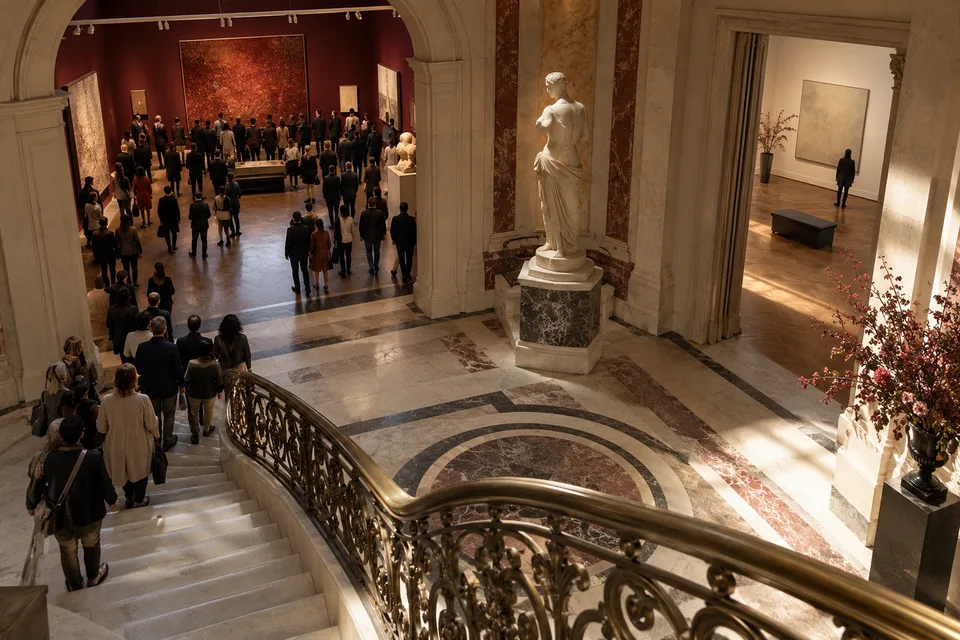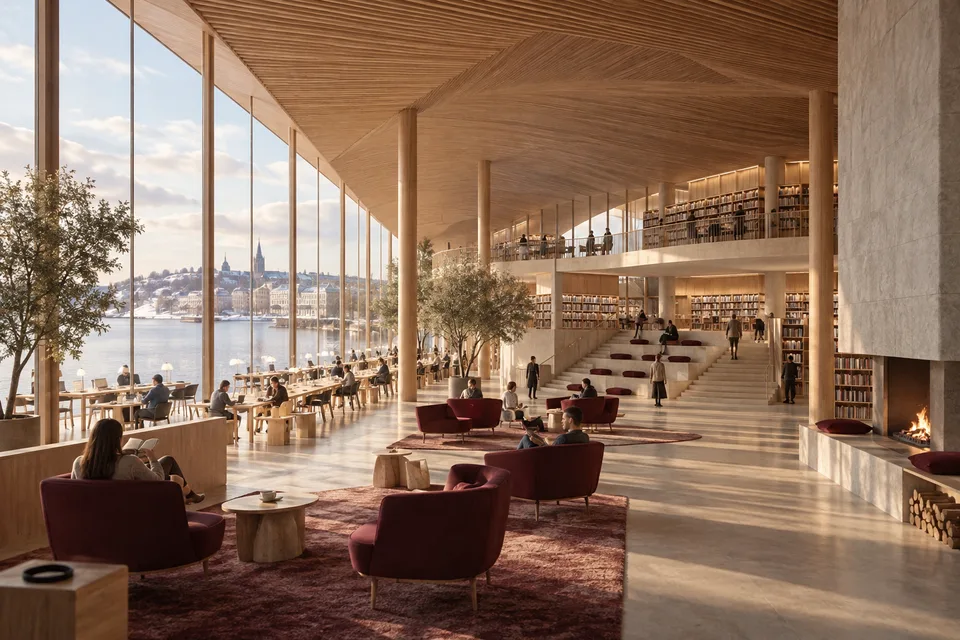
A chair without a minimum spend is a small piece of urban infrastructure. It offers something a café table cannot quite promise: permission to remain without repeatedly converting time into a purchase. Add warmth, light, information and other people, and the chair becomes part of a civic interior.
Helsinki Central Library Oodi makes an unusually ambitious version of that proposition. Its services include books, studios, meeting spaces and equipment for making things. Yet its value is not exhausted by that inventory. A person can enter without having first decided what useful activity will justify the visit.
The building’s less photogenic details deserve attention: a booking calendar, a charge for materials, an instruction session and a notice that equipment is broken. These arrangements determine how a generous interior becomes something people can actually share. They are as much a part of the civic project as its curved ceiling.
The room before the program
Oodi’s services page for visitors states that entry to all three floors is free, with much available without a library card. Some services do require membership or reservations, and commercial activities such as the restaurant and cinema have their own arrangements. “Free to enter” is a precise and valuable condition; it should not be inflated into a claim that every activity or material in the building costs nothing.
The distinction also clarifies what the public room is for. A visitor does not need to borrow a book to enter. Someone using a studio does not have a stronger claim to the building’s civic value than someone quietly reading their own material. A library can support productive activity without making productivity its admission test.
That is a significant choice in a city where many comfortable indoor spaces have a transaction attached. The alternative to a commercial interior is not necessarily an empty hall. It can be a well-supported place in which different activities coexist and some time remains unassigned.
The unassigned time is difficult to defend through conventional output measures. It produces no obvious ticket sale, booking or completed workshop. It may still be the reason a person returns, feels able to enter or encounters something they did not know they wanted. A civic institution needs an account of value broad enough to include that possibility without claiming to measure every private benefit.
Three floors distribute permission
The library’s architecture description explains ALA Architects’ division of functions into an active ground floor, an enclosed middle level for more specific activities and a calmer upper floor known as Book Heaven. The competition-winning design dates to 2013. Its three-part organization is not just an aesthetic composition; it gives different behaviors a place in the same building.
A busy public lobby and a concentration-oriented reading area make different acoustic and social demands. Treating them as one undifferentiated “flexible space” would leave users negotiating those differences at every visit. Oodi’s arrangement instead makes some of the negotiation architectural.
The middle floor is especially revealing. Studios, workspaces and equipment do not have to compete with every reading seat for an identical kind of quiet. More enclosed uses sit between the active entrance and the open upper level. The building can contain activity without announcing that the traditional library has been replaced.
This is a useful answer to an unhelpful cultural argument. Books and making are sometimes treated as rival futures, with one proving the institution’s seriousness and the other its relevance. A spatial program can support both while leaving room for people who use neither in the expected way. The question is not which activity wins the photograph; it is whether each has conditions in which it can work.
The architecture also has to function after the opening celebration. A generous interior needs cleaning, maintenance, staffing and a response to changing demand. Its apparent ease is an operating achievement as well as a design one. Copying the curved ceiling without providing the supporting service would reproduce the image of a public library while weakening the public part.
A machine can be free while its use has conditions
Oodi’s Urban Workshop offers equipment ranging from sewing and electronics workstations to digital fabrication and media tools. Its published arrangement uses Helsinki’s Varaamo reservation service; equipment use is free, while materials can carry a fee. The page directs users to device-specific terms and instructions and describes help for different skill levels within staff capabilities and available time.
The careful wording is a strength. A person gains access to an expensive capability without receiving a promise of an unlimited private technician. Shared equipment needs bookings, instructions and boundaries if many users are to benefit. Conditions can sustain access rather than contradict it.
But there is another side to reservations. A digital booking process rewards people who know that the equipment exists, understand the terms and can plan around the available times. The building’s open door does not remove those informational differences. Staff explanation, clear instructions and the ability to ask a basic question can be as important as the device itself.
When checked in October 2026, the service page reported a broken laser cutter and temporary unavailability. That notice is a modest but telling part of the institution’s public account. A real workshop has downtime. Publishing it gives a would-be user more useful information than an immaculate list of capabilities that fails to say whether they can presently be used.
A new library planning a similar workshop should therefore ask about the whole service. Who maintains the equipment? Which materials are suitable? What can a beginner reasonably achieve during a booking? What happens when a machine is unavailable? The purchase of the object is the start of providing access, not its completion.
The studio is an invitation with a key
The studio service makes the same balance visible in another form. Oodi offers spaces for music, voice, photography and video, with advance booking. Access requires a valid ID and a library card with borrowing rights. The recording studio provides an introductory route with an instructor as well as independent use for more experienced users under its arrangements.
These details distinguish a public resource from the romantic idea of an entirely frictionless one. A shared studio needs to protect equipment and allocate scarce time. The question is whether its conditions are understandable, proportionate and matched by help that allows newcomers to begin.
There is a civic argument for offering such tools alongside books. People participate in culture by producing it as well as consuming it. A recording space or editing workstation can broaden who gets to make something with usable equipment. That does not require the library to judge every project by its professional quality or its eventual audience size.
Learning is a legitimate outcome. So is an unsuccessful experiment that helps someone understand the next attempt, provided the activity respects the shared resource. A public workshop becomes less open if it quietly assumes everyone must arrive already competent enough to make efficient use of every minute.
Oodi’s service language acknowledges this by making getting started part of the promise while retaining limits on staff time. It is a more credible form of generosity than advertising boundless assistance. The resource remains shared because expectations are stated before a person’s project encounters them.
Open does not mean indifferent
A public interior brings together people whose needs can conflict. The answer cannot be to remove every rule in the name of openness, nor to let a narrowly defined preferred user determine who belongs. The institution needs a way to protect ordinary coexistence.
Oodi’s Safer Space Principles address respect, harassment, behavior and shared responsibility. They explicitly avoid guaranteeing that every person will always experience the building as safe. That qualified language recognizes an ongoing task, rather than declaring that a published policy has settled the matter.
The principles connect individual freedom with the presence of others. A person’s right to space and peace exists alongside other visitors’ rights. Staff need support to act when behavior undermines those conditions. The building’s physical openness makes this work more important, not less necessary.
The difficult decisions occur in application. A rule that looks neutral can be applied selectively; a generous policy can become ineffective if nobody is able to enforce it. Public reporting and user feedback can help an institution understand those differences. A beautiful interior is not evidence that every visitor has an equally comfortable relationship with it.
This should temper, rather than extinguish, enthusiasm. The civic achievement is not a room without conflict. It is a room where a public institution accepts responsibility for making shared use possible, with principles that can be questioned and improved.
Count visits without reducing visitors to a count
Helsinki’s Facts and Figures 2026 records almost 2.7 million Oodi visits in 2025. These are visits, not 2.7 million unique people, and the total alone cannot say how long someone stayed or what the experience meant. It establishes heavy use, not a complete verdict on the building’s public value.
The city’s 2025 library-service account, published in January 2026, also reports Oodi’s record of more than 575,000 loans. The building’s broader program has therefore not made borrowing irrelevant. The same account describes a citywide library network, including neighborhood locations and mobile libraries; Oodi is an important part of that network, not a substitute for it.
The same city account gives a more deliberate answer to who learns to enter. In 2025 Helsinki added a fifth-grade library visit focused on environmental education and multiliteracy, joining existing visits in first, third and seventh grades. That school partnership creates repeated encounters across an age group, rather than waiting for a family to discover a landmark building. It is a citywide program, not an Oodi-only attendance result. A central destination is valuable, while routine access also depends on local branches, mobile services and invitations that reach people where they already are.
Evaluation could hold several measures together: borrowing, use of specialist spaces, availability of seats, user experience and reach across communities. It could ask who struggles to obtain a booking or feels unsure about entering. Not everything valuable will become a neat metric, but leaving those questions out because they are harder to count would narrow the institution’s purpose.
Leave something unbooked
The most transferable Oodi lesson is not a particular machine, ceiling or floor plan. It is the relationship between permission and support. People can arrive without a purchase, find different kinds of room and encounter services whose conditions are publicly described. The institution does the work of maintaining that possibility.
This makes “doing nothing” a more serious phrase than it first appears. A person resting, thinking or waiting is still using the city. A public interior need not demand a documented output before recognizing that use as legitimate. At the same time, it can provide remarkable tools for the moment when someone does want to begin.
The chair without a minimum spend is therefore not leftover space between the important activities. It is part of what makes the activities public: the assurance that entering the building does not require having already earned a reason to be there.
Sources & context
This article draws on the sources linked in the text. Analysis and illustrative scenarios are identified separately from reported findings.
- services page for visitors
- architecture description
- Urban Workshop
- studio service
- Safer Space Principles
- Facts and Figures 2026
- 2025 library-service account