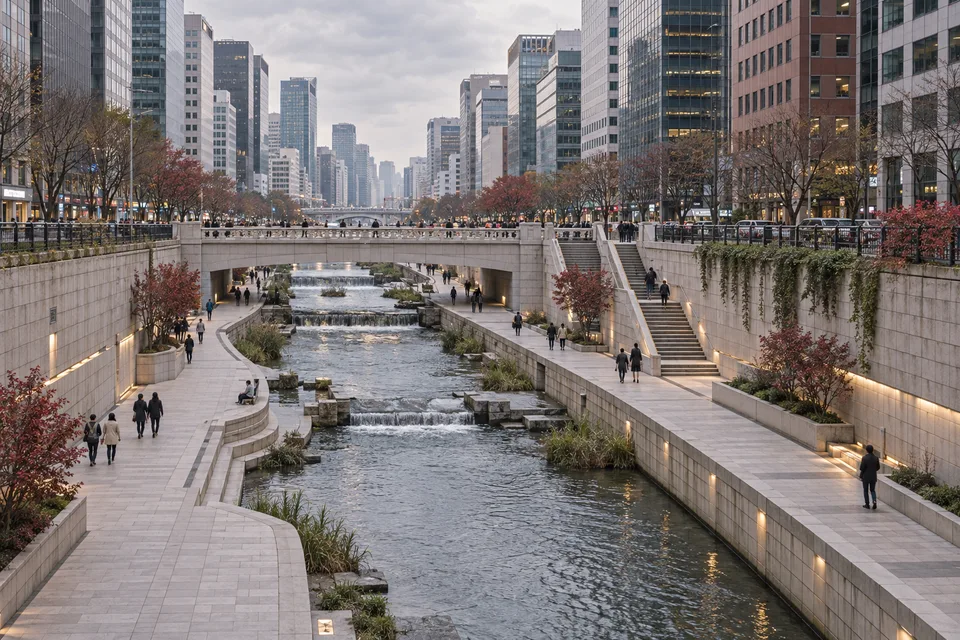
The familiar pairing is almost too persuasive: an elevated road in one photograph, an open stream in the other. One stands for a city surrendered to vehicles; the other for nature returned. Seoul’s Cheonggyecheon genuinely changed the center of the city. The pairing becomes misleading when it suggests that the second landscape no longer requires engineering, money or difficult choices.
An urban stream can be both an environmental improvement and an actively maintained public work. A new public space can be popular while changing the economic prospects of the people around it. A restored historical feature can make the past more visible while selecting which part of that past to present.
Cheonggyecheon is useful precisely because these relationships are visible. Read through official records, operating information and research, it becomes more than a model to copy. It becomes a way to ask what restoration means in a city that continues to change around the restored place.
I. The road had a history too
The Cheonggyecheon Museum’s historical account describes a stream long embedded in Seoul’s urban life, later covered as road infrastructure developed. It records the restoration project beginning in July 2003 and the reopened stream on 1 October 2005, across a corridor of about 5.84 kilometers. The covering and elevated road had once represented modernization themselves.
That earlier meaning matters. The project did not simply remove an inexplicable mistake from an otherwise natural city. It reversed a previous development choice that had been associated with industry, movement and progress. The landscape before restoration was also a product of public priorities and an economy built around them.
This makes “return” an incomplete description. The contemporary project did not recreate every physical and social condition of an earlier stream. It produced a new urban landscape using selected historical references, modern infrastructure and present-day expectations of public space. Recognizing that construction does not make the restoration fraudulent. It makes the design choices available for discussion.
A museum can help by showing more than the triumphant transition. The road, the businesses around it and the reasons people once wanted the water covered belong to the history too. A landscape becomes a weaker civic memory if it presents only the past that most comfortably endorses its current form.
For another city considering a similar intervention, the first question is therefore local. What does the existing corridor do, and for whom? Traffic movement is one answer, but there may also be workplaces, access routes, networks of suppliers and less visible uses. Removing a structure changes more than its silhouette.
The transport question cannot be settled by the international popularity of the final image. A city needs a credible account of movement before, during and after the work, including alternatives and the people who depend on them. A road’s removal can be justified without pretending the previous trips vanish without consequences or adaptation.
The same principle applies to the word “underused.” Space can look inefficient in a redevelopment presentation because its users are difficult to count or its activities are considered low value. A careful account investigates the use before declaring the land available for a better one. Otherwise, the project’s social history is edited before construction begins.
II. Follow the water to its source
The current Seoul Facilities Corporation overview identifies treated Han River water and incoming groundwater in the stream’s maintenance supply. Its table lists 40,000 tonnes a day of treated river water, with flexible supply up to 120,000, alongside 20,000 tonnes a day of groundwater from sources including the subway and electricity infrastructure. The distinction between the stated river-water supply and its higher flexible limit matters: adding the maximum to the groundwater figure would not establish an observed daily flow.
That information changes the meaning of the landscape without erasing its value. Water moving through the corridor is part of an engineered circulation. The public space can provide a meaningful relationship with water while depending on treatment, pumping and maintenance outside the view most visitors photograph.
The appropriate question is what the complete system delivers for its costs and dependencies. Energy used to move water belongs in that assessment. So do water quality, maintenance and the public use supported by the corridor. An intervention does not become environmentally worthless because it has operating inputs; nor do attractive outcomes make those inputs irrelevant.
It is especially important to distinguish a landscape’s different claims. Providing a pleasant waterside route, improving particular environmental conditions and restoring a self-sustaining ecological system are not identical achievements. The evidence required for each differs. A project should identify what it has actually created rather than let the broad word “nature” stand in for every outcome.
Myung-Rae Cho’s 2010 analysis of the restoration’s politics examines conflicts between the city government’s managerial approach and environmental groups seeking a different ecological restoration. It is a critical scholarly interpretation of the project, not a current engineering inspection. Its contribution is to show that disagreement concerned the kind of nature being made, rather than a simple division between people favoring nature and people opposing it.
That debate remains transferable. A channel designed for public access, flood conveyance, ecological function and visual appeal may face tensions among those purposes. The responsible response is to state the priorities and investigate the trade-offs. It is less helpful to declare the entire project either perfectly natural or entirely artificial and stop asking questions.
Access is an operating matter too. The operator’s overview lists stairs, ramps and elevators, but an entrance inventory is only part of whether a route is usable. A person needs a continuous journey from the surrounding city to the desired place and back. Availability, maintenance and understandable information determine how the nominal access works in practice.
Rain changes the operating task completely. The corporation’s storm-response plan describes round-the-clock monitoring and field staff carrying out evacuation and access control on instructions from the control room. A notice dated 22 July 2026 records a closure from the upstream starting section to Hwanghak Bridge after a nearby station detected 3.5 millimetres of rain in fifteen minutes. That is one recorded closure, not a permanent threshold inferred for every section. A useful waterside route has to become temporarily unavailable when conditions require it; the city is maintaining public access partly by knowing when to stop it.
III. The improvement travels into property
An attractive public space can change how surrounding land is valued and used. That is often one of the intentions of regeneration. It is also why an account limited to the new path and water cannot describe the full outcome.
A 2013 land-use study of the Cheonggye Stream project examined changes in Seoul’s central business district and argued that regeneration and gentrification describe the same process from different stakeholder perspectives. Its study area showed movement toward commercial and office uses and pressure on industrial activities. This is evidence about the places and period examined, not a claim that every surrounding firm disappeared or that the entire city followed one uniform trajectory.
The finding complicates a familiar success measure: rising land value. That increase can be a benefit to an owner and a pressure on a tenant. More visitors can support one business while the changing mix of uses makes another less viable. A public-space improvement does not need to be rejected because these effects occur. They need to be included in what is being evaluated.
Small industrial and trading activities can be particularly hard to represent in a leisure-oriented vision. Their value lies partly in proximity: a supplier, repairer and customer close enough to work together. Moving each to a formally available location may not preserve that network. An inventory of relocated businesses can therefore miss a loss of practical relationships.
The question for policy is what support or protection is appropriate, and when it must occur. Measures considered only after rents rise or a network breaks may have fewer options. A credible regeneration plan should investigate likely effects before announcing that everyone will benefit from the same improvement.
It also needs to distinguish attribution from coincidence. Surrounding development is influenced by several forces, not solely the stream. A study can investigate the project’s relationship to change, while a broader assessment should retain the economic and policy context. The strongest criticism is specific about mechanisms and evidence rather than assigning every later loss to one construction project.
For public communication, this means giving beneficiaries more than one identity. Residents, visitors, workers, owners and tenants can have overlapping interests, and the same person can occupy several roles. A worker may enjoy the stream while worrying about the future of the workplace. A simple count of people enjoying the space will not reveal that conflict.
The public investment should be judged through that complexity. It can deliver valuable access and environmental benefits while requiring additional policy to distribute the gains more fairly. The presence of a difficult trade-off is a reason to govern the change, not an excuse to hide it behind either celebration or condemnation.
The next twenty years
The anniversary has not frozen the corridor. Seoul’s 2025 announcement of new nightscape work described phased lighting and nighttime-design plans along three kilometers by 2027. This was an announced program and timetable, not evidence that all proposed work is complete. It shows the restored stream becoming the subject of another design agenda.
Nighttime improvements introduce another set of choices. Visibility, public enjoyment, energy, maintenance and ecological considerations need to be weighed together. A landscape’s popularity can create pressure to add ever more programming, while quieter use and habitat may call for restraint in some places. The next intervention should be assessed on its own merits rather than inherit automatic approval from the restoration’s reputation.
The city’s 2025 water conference announcement similarly framed the anniversary around urban resilience and water circulation. The useful opportunity is to treat a landmark as a source of continuing evidence: what works, what costs more than expected, whose use has changed and what must be maintained.
A long-term record should separate construction spending from the recurring cost of keeping the place available. It should also distinguish use from benefit: a visit count establishes activity, while questions about accessibility, environmental function and surrounding livelihoods need other evidence. An anniversary is a useful moment to publish those different accounts together, including results that complicate the original story.
For another city, that record would be more useful than a promise to build its own Cheonggyecheon. The transferable lesson might be a transport decision, an operating arrangement or a way of supporting existing businesses. The visible form is only one part of what needs to be understood before an intervention can be adapted to another place.
Cheonggyecheon’s next chapter will be written partly in work that makes a poor before-and-after photograph: water supplied, structures maintained through seasonal changes, access kept usable and redevelopment decisions made around the corridor. That work belongs alongside the celebrated removal of the road. Seoul made a deliberate choice about the center of the city. The stream’s continuing public value depends on the institutions and resources that keep that choice working for the people around it.
Sources & context
This article draws on the sources linked in the text. Analysis and illustrative scenarios are identified separately from reported findings.
- Cheonggyecheon Museum's historical account
- Seoul Facilities Corporation overview
- 2010 analysis of the restoration's politics
- storm-response plan
- notice dated 22 July 2026
- 2013 land-use study of the Cheonggye Stream project
- 2025 announcement of new nightscape work
- 2025 water conference announcement